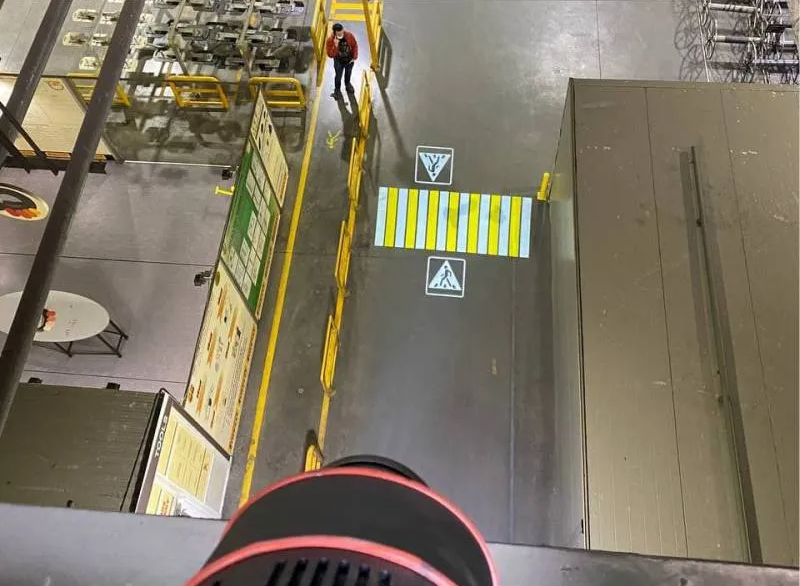
A good warehouse projected-marking pilot tests one real operational problem under representative conditions and ends with a documented decision. It is not a showroom demonstration and not simply a projector left on for a week. The pilot should define the behavior or communication objective, the location, the baseline, visibility criteria, observation periods, maintenance checks and the people authorized to accept or reject the result.
Choose a use case important enough to matter but controlled enough to evaluate safely. Examples include a STOP image at an internal intersection, a pedestrian waiting point, a keep-clear message or a temporary staging boundary. Review the basic projected light demarcation approach before writing the pilot brief so that stakeholders understand the difference between fixed-image signs, projected lines and integrated triggered systems.
Start with a precise pilot question
The pilot needs a question that can be answered. “Do employees like projection?” is subjective and too broad. “Is the approved STOP image legible from both forklift approaches during all operating shifts without being obscured by normal stock movements?” is specific and testable.
Define:
- the marking’s intended safety or process function;
- the viewers and approach directions;
- the physical marking or sign it supplements during the pilot;
- the operating shifts and lighting states to be observed;
- the pilot start and end dates;
- acceptance criteria and decision owners;
- fault and fallback procedures.
Keep required existing controls in place unless removal has been separately approved. A pilot should not create a regulatory or operational gap. If the aim is eventual replacement of paint, tape or a decal, the pilot can compare performance while both methods remain visible.
Also decide what is outside scope. A fixed always-on image does not validate a future sensor-triggered installation, and a dim indoor aisle does not validate a bright dock doorway.
Choose a representative but manageable location
The easiest location may produce the least useful result. Select a site that represents the problem you want to solve, including actual mounting height, lighting, floor finish, traffic and contamination. At the same time, avoid beginning at the facility’s most complex or highest-consequence hazard if a failure would be difficult to manage.
A strong pilot location has:
- a clear operational owner;
- stable access for mounting and inspection;
- measurable viewing positions;
- representative pedestrian or vehicle traffic;
- known lighting changes across the day;
- a floor surface similar to likely rollout areas;
- a practical temporary fallback.
Document mounting height, desired image size, horizontal offset, floor color and texture, nearby luminaires, daylight sources, vibration, dust, temperature and possible obstructions. These factors drive optical and power selection. Do not assume that a projector successful at one ceiling height can simply be moved to a higher bay with the same image size and result.
Set acceptance criteria before installation
Predefined criteria protect the pilot from becoming a contest of opinions. Include technical, operational and maintenance measures. Avoid invented precision: if the site has no validated numerical visibility threshold, use structured observations from fixed positions and obtain approval from responsible safety personnel.
Possible criteria include:
- correct image content, dimensions, orientation and location;
- legibility from named approach points and vehicle-cab positions;
- acceptable visibility in each required lighting state;
- no obstruction during normal stock and traffic patterns;
- stable focus and alignment over the pilot period;
- successful start-up, switching or scheduled operation;
- manageable cleaning and inspection requirements;
- clear employee understanding of the message;
- no new glare, distraction or access problem identified by the site review.
Define failure conditions as well. An image that works only with a dock door closed may fail if the process requires that door to remain open. A marking that shifts away from the approved point should trigger correction and investigation rather than an informal tolerance.
Install and observe without biasing the result
Install the pilot as a real system, using a secure mounting point, protected power route and approved artwork. Temporary does not mean improvised. Coordinate overhead access, traffic diversion and electrical work with the warehouse. Photograph the commissioned image from each agreed observation point.
Observe the pilot during normal operations, not only immediately after installation. Include different shifts, cleaning cycles, door positions and expected seasonal or daylight variation where the pilot duration allows. Ask users concise questions: Can you identify the message in time? Is any part routinely covered? Does it conflict with another sign or route? Have you noticed periods when it is weak or absent?
User comments should be recorded, but they are not a substitute for direct inspection. Novelty can make a new projection seem unusually noticeable during the first days. Conversely, unfamiliarity can produce resistance unrelated to actual visibility. Focus on the defined behavior and acceptance criteria.
Record every adjustment to focus, angle, schedule or image. Otherwise the final result may describe a configuration different from the one originally tested.
Turn pilot evidence into a rollout decision
At the end, compare the recorded evidence with the criteria and choose one of four outcomes: accept, accept with changes, extend the pilot for a defined reason, or reject for this application. “Interesting, keep testing” is not a useful conclusion unless the missing evidence and new end date are explicit.
The review should answer:
- Did the marking communicate the intended message in every required condition?
- Which mounting, optical and power configuration was used?
- What cleaning, adjustment or downtime occurred?
- Were existing controls retained, changed or proposed for removal?
- Which other locations genuinely match the tested conditions?
- What conditions require a new assessment rather than copying the pilot?
- What installation, access and training resources would rollout require?
Scale by location category, not by projector count alone. Group areas by mounting height, image size, ambient light, surface and environmental exposure. A successful pilot can support similar locations, but it does not prove operation on every surface or in all warehouse conditions.
FAQ
How long should a projected-marking pilot run?
Long enough to include the relevant shifts, lighting states, cleaning and traffic patterns. The correct duration depends on the use case and seasonal variation; there is no universal number.
Should existing paint or tape be removed for the pilot?
Usually not unless removal has been formally approved. Keeping the existing control allows comparison and avoids creating a gap while the technology is being evaluated.
What comes in a standard pilot equipment package?
The standard scope is remote assessment from photos and dimensions, optical and power calculation, projector, one gobo slide, mounting bracket and standard instruction. Installation and integration are separate.
Can results from one aisle justify a warehouse-wide rollout?
Only for locations with sufficiently similar geometry, lighting, surface and operating conditions. Different location categories should be assessed separately and may need additional trials.
Design a pilot that produces a decision
A useful pilot begins with a survey and ends with evidence that procurement, operations and safety teams can review. It should reveal not only whether the image looks good, but whether it remains correctly placed, visible, understood and maintainable in normal warehouse work.
Prepare photographs, dimensions, the proposed message, required image size, floor details and lighting observations. Consult the warehouse projection system overview to define an appropriate scope. Then submit the pilot location for assessment. Any engineering installation plan, sensor or equipment connection, installation labor, travel and consumables can be quoted separately and made visible in the pilot budget.