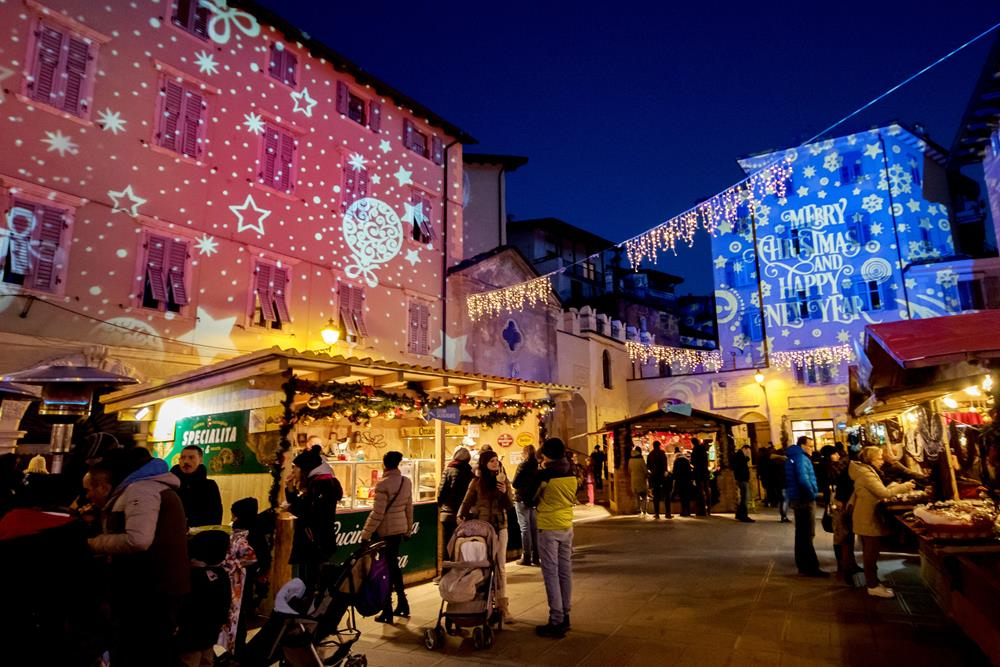
A gobo projector lens determines how large the image becomes at a given throw distance and how the available light is distributed across that image. Lens selection is therefore a geometry and visibility decision, not an accessory choice made after the projector is ordered. Start with a measured mounting distance and a target image size, then use data for the exact projector and lens. Terms such as wide, standard and narrow are relative, so they cannot replace a projection chart, lens ratio or other manufacturer-specific information.
What the Projection Lens Controls
The lens collects the image formed at the gobo and focuses an enlarged version on the target. Its optical design influences projection angle, achievable image size at a given distance and focus behavior. The lens also affects light concentration because the same available light may cover a small or large area.
A lens does not correct every site problem. It cannot make a dark, textured surface behave like a pale matte wall, remove strong ambient light or compensate for an unstable mount. Review the complete project through the gobo projector buying guide, then use lens data to refine a feasible setup.
Focal Length, Beam Angle and Lens Ratio
Longer focal lengths generally produce a narrower projection angle, while shorter focal lengths generally produce a wider angle, within a compatible product family. Beam angle describes the angular spread. Lens or throw ratio describes the relationship between throw distance and image dimension, although manufacturers may define and publish values differently.
Always confirm which image dimension the data uses. It may refer to width, diameter or another field definition. Also check whether distance is measured from the front lens, fixture body or mounting point. Small definition differences can create large errors on site. Model-specific charts remain more reliable than applying a generic rule to unrelated projectors.
Wide, Standard and Narrow Projection Lenses
A wide lens is useful when the projector is close to the target but the image must fill a larger area. It may also make edge focus and angled mounting more noticeable. A standard lens covers the middle range defined by the manufacturer. A narrow lens is used when the projector is farther away or when the image must remain relatively small.
These labels do not guarantee interchangeability. Confirm that the lens is approved for the projector, gobo format and intended environment. Do not assume a lens can be swapped in the field unless the product documentation supports it. For industrial systems, the projector range for industrial applications provides a relevant starting point, but available optics still require confirmation.
How Lens Choice Affects Image Size
At the same throw distance, a wider projection angle normally creates a larger image and a narrower angle creates a smaller one. At the same lens setting, moving the projector farther from the surface normally increases image size. Exact dimensions depend on the optical combination.
Define whether the requested size is the full illuminated field, the visible artwork, a circular diameter or a rectangular logo width. Transparent or empty margins in the artwork can make the visible logo smaller than the nominal projection field. The gobo projection size and distance guide covers the measurement workflow and checks for available surface area.
How Lens Choice Affects Light Concentration
When an optical system spreads available light over a larger image, apparent brightness at the surface usually falls. A narrower field can concentrate light into a smaller area, although total performance also depends on the projector, lens transmission, gobo and focus. This is why image size belongs in every visibility discussion.
A narrow lens is not an automatic cure for bright surroundings. If the required image must be large or ambient light is strong, the system still needs evaluation. Surface color and texture can further reduce contrast. Compare proposed options at the intended operating time and, for demanding or permanent work, consider a representative test.
Measurements Needed Before Selecting a Lens
Collect dimensions from the real installation:
- throw distance from the expected lens position to the surface;
- desired visible artwork width and height or diameter;
- maximum clear projection area;
- horizontal and vertical offset from the image center;
- mounting angle and available adjustment space;
- surface photos and ambient-light conditions.
Include the projector model if it is already owned, plus current lens markings and gobo size. A photo of the label can prevent confusion. If dimensions are estimates, provide minimum and maximum values so the supplier can check whether one optical option covers the range.
Lens planning should also include commissioning tolerance. A calculation that places the required image at the extreme edge of an optical range leaves little room for field adjustment. The finished wall may be closer than the drawing suggests, or the mount may need to move to avoid a pipe. Ask whether the selected combination permits useful focus and size adjustment around the target value. If not, compare another mounting point or lens before purchase. Edge quality deserves attention too. A logo with important detail near the outside of the field may reveal softness or distortion more readily than a centered compact symbol. Evaluate the actual artwork orientation, not only a generic test circle. Keep the lens clean and handle it as the manufacturer directs; fingerprints, dust or incorrect seating can undermine an otherwise sound optical choice. The objective is not to maximize image size, but to produce the required image with enough margin for real installation conditions.
Send Your Dimensions and Request a Quote
Submit the measured distance, desired size, surface, ambient light, mounting position, indoor or outdoor conditions and artwork. The supplier can then match those inputs to compatible projector and lens data rather than guessing from a room photo.
FAQ: Can I choose a lens by beam angle alone? Beam angle helps, but model compatibility, field definition, focus range and manufacturer data must also be checked.
FAQ: Does a wider lens make the image dimmer? A larger image usually spreads light over more area, but the actual result depends on the complete optical system.
FAQ: Can any lens fit any gobo projector? No. Mechanical, optical, thermal and environmental compatibility are model specific.
FAQ: What if the mounting distance may change? Provide the possible range and target size so suitable options or mounting limits can be reviewed.
Use the measurements to request a quote for a matched projector and optical setup.